Look — Naturalist Specimen Card
Type any object. Get a Victorian, Art Deco, Ming Dynasty, or mid-century specimen plate — annotated, plated, illustrated.
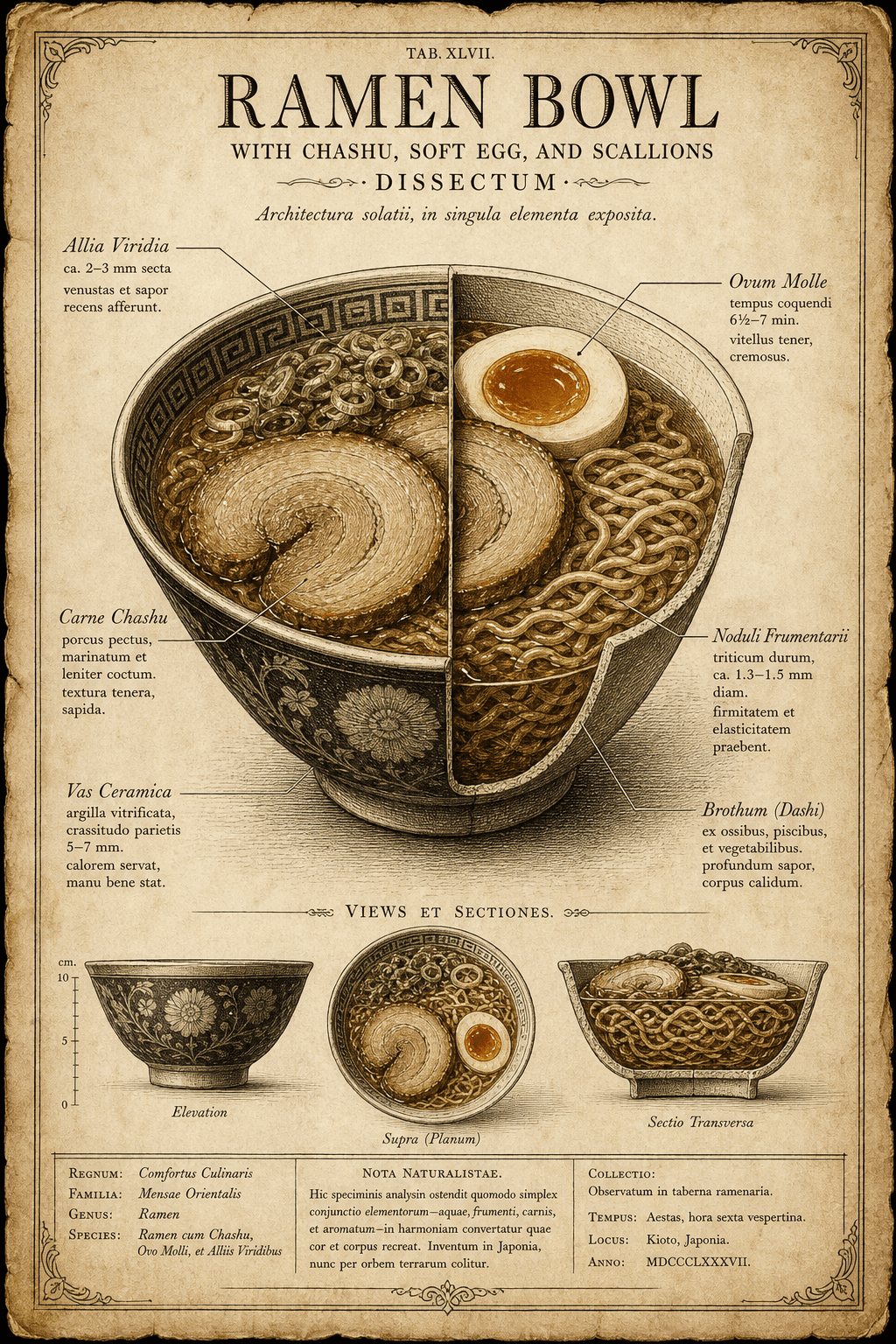
Take any everyday object — a ramen bowl, a mechanical keyboard, a mechanical pencil, a sneaker, an iPhone — and treat it as a museum specimen. The Naturalist Specimen Card cross-sections it, annotates it, plates it against a chosen background, and illustrates it in the visual register of a chosen era. Four eras, four backgrounds, four annotation languages. The era FORBIDDEN-cue blocks keep Victorian engraving from leaking into Art Deco geometry, Ming-Dynasty ink-painting from leaking into Eames-era flat illustration.
What you bring
- A subject — ramen bowl, mechanical keyboard, scholar's ink-brush set, skateboard. Mundane is fine; naturalist gravity makes anything interesting.
- An era — 1800s Victorian engraving, 1920s Art Deco, Chinese Ming Dynasty ink, mid-century modern. Determines the visual register and typography family.
- A background — parchment, blueprint blue, chalkboard black, botanical cream. Determines where the specimen lives.
- An annotation language — English, Latin, Chinese, pseudo-scientific (mixed Latin / English). Each callout renders in the chosen language.
What you get back
A specimen plate with the subject as the dominant illustrated element — half-intact, half-dissected where internal structure exists; multi-view where it doesn't. 4-6 callouts with thin clean leader lines, each labelled with a structure name, a one-line composition / spec, and a one-line plain-language description. Title in display typography appropriate to the era. Italic subtitle. Optional supplementary views and specimen data block. Reads as a museum catalogue plate, not a product photo.
Mundane objects, naturalist gravity
The prompt instructs the model to treat the subject "with reverent scientific gravity, regardless of how mundane the object is in real life." A ramen bowl gets the same treatment Audubon gave a bird; an iPhone gets the same treatment a Ming-Dynasty scholar gave the four treasures of the study.
Cost & timing
8 credits per run. Roughly 70 seconds (annotated specimens take longer than single subjects). With your 20 signup credits you get two before topping up.
Inspired by @GeekCatX on X — the seminal "Naturalist food cross-section" prompt with extremely detailed structural-callout framing in a 3-line label format. The broader botanical / symmetrical-print register came from @dotey. The four-era × four-background × four-language enforcement, slot scaffolding, and per-era FORBIDDEN-cue blocks are FluxGen's.